Astronomers observe largest ever sample of galaxies up to over 12 billion light years away

The largest sample of galaxy groups ever detected has been presented by a team of international astronomers using data from the James Webb Space telescope (JWST) in an area of the sky called COSMOS Web. The study marks a major milestone in extragalactic astronomy, providing unprecedented insights into the formation and evolution of galaxies and the large-scale structure of the universe.
Peering back in time to when the universe was younger than the Earth is now, the images span the period from around twelve billion years ago until one billion years ago. The new catalogue of images, soon to be published in the journal Astronomy and Astrophysics (A&A), includes nearly 1,700 galaxy groups. The research group’s impressive image of a galaxy cluster over 6 billion light years away will be showcased as the European Space Agency’s (ESA) picture of the month from April 29.
‘We're able to actually observe some of the first galaxies formed in the universe,’ says Ghassem Gozaliasl of Aalto University, and head of the galaxy groups detection team who led the study. ‘We detected 1,678 galaxy groups or proto-clusters – the largest and deepest sample of galaxy groups ever detected – with the James Webb Space telescope. With this sample, we can study the evolution of galaxies in groups over the past 12 billion years of cosmic time.’
The James Webb Space Telescope began operating in 2022. The largest telescope in space, its higher resolution and greater sensitivity have enabled astronomers to see farther and better than ever before. Because light travels at a finite speed, the further away an object is, the further back in time our image of it. By observing very faint, very distant galaxies – the faintest galaxies in this dataset are one billion times dimmer than the human eye can see – the team got a glimpse of what galaxies looked like in the early universe.
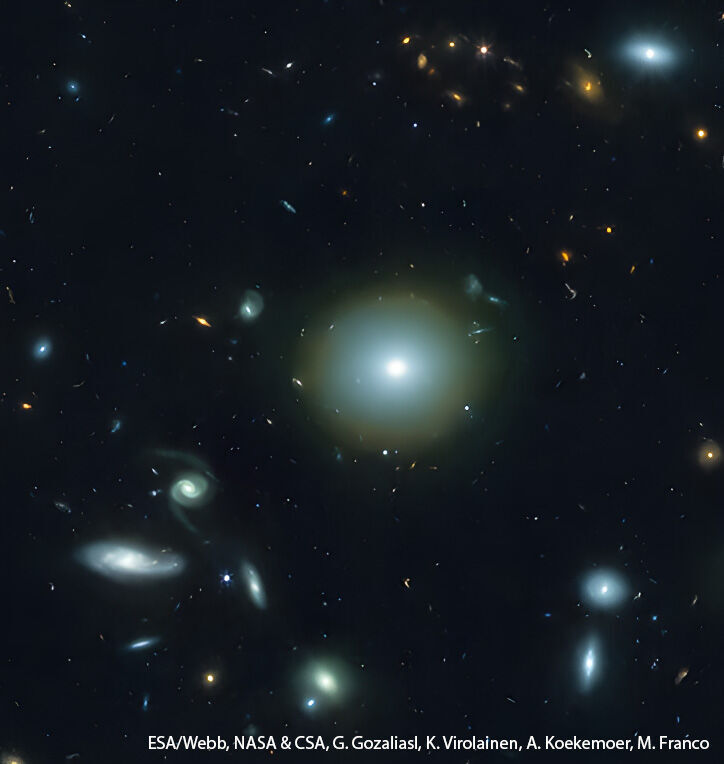
Galaxy groups and clusters are rich environments filled with dark matter, hot gas, and massive central galaxies that often host supermassive black holes, explains Gozaliasl. ‘The complex interactions between these components play a crucial role in shaping the life cycles of galaxies and driving the evolution of the groups and clusters themselves. By uncovering a more complete history of these cosmic structures, we can better understand how these processes have influenced the formation and growth of both massive galaxies and the largest structures in the universe.’
Cosmic family history
Galaxies aren’t scattered evenly throughout the universe. Instead, they cluster in dense regions connected by filaments and walls, forming a vast structure known as the cosmic web. Truly isolated galaxies are rare — most reside in galaxy groups, which typically contain anywhere from three to a few dozen galaxies, or in larger galaxy clusters, which can include hundreds or even thousands of galaxies bound together by gravity. Our own Milky Way is part of a small galaxy group known as the Local Group, which includes the Andromeda Galaxy and dozens of smaller galaxies.
‘Like humans, galaxies come together and make families,’ explains Gozaliasl. ‘Groups and clusters are really important, because within them galaxies can interact and merge together, resulting in the transformation of galaxy structure and morphology. Studying these environments also helps us understand the role of dark matter, feedback from supermassive black holes, and the thermal history of the hot gas that fills the space between galaxies.’
Because the new catalog includes observations that span from one billion to twelve billion years ago, scientists can compare some of the earliest structures in the universe with relatively modern ones to learn more about galaxy groups and how they evolve. Studying the history of galaxy groups can also help astronomers understand how the giant, brightest group galaxies (BGGs) at their centres form through repeated mergers — an area explored in depth across several of Gozaliasl’s recent publications.
‘When we look very deep into the universe, the galaxies have more irregular shapes and are forming many stars. Closer to our time, star formation is what we refer to as ‘quenched’ –– the galaxies have more symmetric structures, like elliptical or spiral galaxies. It’s really exciting to see the shapes changing over cosmic time. We can start to address so many questions about what happened in the universe and how galaxies evolved,’ says Gozaliasl.
Further resources:
The latest peer-reviewed study, and catalog of images, is scheduled for publication in late April/early May:The COSMOS-Web deep galaxy group catalog up to z=3.7, Greta Toni, Ghassem Gozaliasl, Matteo Maturi, Lauro Moscardini, Alexis Finoguenov, Gianluca Castignani, Fabrizio Gentile, Kaija Virolainen, et al. A&A, Forthcoming article. Received: 15 January 2025 / Accepted: 27 March 2025, DOI 10.1051/0004-6361/20255379
A pre-print of the paper is available HERE.
Media gallery: Images available for media use in connection with the research HERE. Credits: ESA/Webb, NASA & CSA, G. Gozaliasl, A. Koekemoer, M. Franco, K. Virolainen.
Each image combines the sharp infrared vision of the James Webb Space Telescope (JWST) and Hubble Space telescope (group 1 and 15) with soft, glowing overlays of X-ray emissions, revealing the hot gas trapped within massive cosmic structures.
This news item was originally published on the Aalto University website on 28.4.2025
Read more news

AI can help run factories better: University of Helsinki thesis sharpens the 3D models
A collaboration between the University of Helsinki and the Finnish company Twinverse has tested how well today's AI can label the individual objects inside 3D models of industrial sites, and where it still falls short.
Meet our Fellow: Junhao Li
We ask our fellows more about themselves and their research. For this article we ask our Fellow Junhao Li more about his research. Junhao is currently working under the supervision of Dorota Glowacka at the University of Helsinki Department of Computer Science
Emotions help explain why people click phishing emails
People are currently taught to recognise phishing attempts in ways that may be counterproductive. Researchers call for information security training to take emotions into account more effectively.