Jarno Alanko
HIIT Postdoctoral Fellow 1.2.2023-31.12.2025
As the new director of HIIT, it is a great pleasure to write this overview to the annual report 2025 of Helsinki Institute for Information Technology HIIT. HIIT is a joint research institute established in 1999 by Aalto University (previously, Helsinki University of Technology) and University of Helsinki. I would like to take this opportunity to thank my predecessor Professor Petri Myllymäki whose leadership has ensured that HIIT continues to provide excellent results some 25 years after its founding.
The mission of HIIT is to enhance the quality, visibility and impact of Finnish research on information technology, through facilitating and carrying out basic and strategic research in information technology, meeting international standards of excellence, and close cooperation with the information industry and with sciences applying information technology.

HIIT is centered around three academic departments in the University of Helsinki and Aalto University that focus on information and communications technology, defining the HIIT community:
The current strategy of HIIT has been to support its mission by focusing on attracting new postdoctoral researchers to join the HIIT community. This has been very successful, as witnessed by the large pool of excellent early-career researchers (HIIT Postdoctoral Fellows) and few exceptional, more senior researchers (HIIT Research fellows) we have hosted in past years. The recruitment to these fixed-term positions is primarily excellence-based, aiming to bring the best young researchers in the HIIT community, but keeping an eye on the fit to the HIIT community and balanced allocation of HIIT resources. After the post-doc period, HIIT Fellows continue their careers either in academic faculty positions or become experts in the Finnish industry and society. The HIIT-funded fellows in 2025 and their research profiles can be found in Section ‘HIIT Fellows’ together with examples of their research results.
The section ‘Publications’ summarizes the main statistics of 2025 regarding all publications produced by the HIIT community as a whole. All in all, the research output shows a nice increasing trend past years in peer-reviewed research output. Additionally, we have provided the number of publications by our HIIT Fellows as well as the publications based on a collaborative effort within the three hosting departments of HIIT. For particularly influential publications or other impactful research results we have published a highlight news item, which are collected in section ‘Highlights’.
In the section ‘Funding’, we summarize the use of the HIIT basic funding from the two host universities. As can be seen here, the HIIT basic funding is relatively small (ca. 5% of total research funding of the HIIT host departments), thus HIIT needs to be quite strategic and focused in its investments of money and efforts. We believe that the current strategy of focusing on supporting talent attraction on the postdoctoral level produces a good return of investment and clearly creates added value. In addition to supporting early-career researchers, HIIT has an important role in facilitating activities of the HIIT community. HIIT co-funded several topical events, including Helsinki Algorithms and Theory Days, Helsinki Digital Humanities Hackathon and HIIT Open Programming Contest. In addition, HIIT supported international visits and travel of researchers.
The Scientific Advisory Board of HIIT, chaired by Prof. Barry O’Sullivan, met in Summer 2025 to review the HIIT operations and to provide feedback. The SAB summarized: “HIIT has demonstrated considerable success in recruiting top-tier postdoctoral talent and establishing Helsinki as a competitive European research hub. Its role as a facilitator for collaboration between the University of Helsinki and Aalto University is highly valued, leading to significant national initiatives like FCAI and the ELLIS Institute Finland.” The SAB recommendations included strengthening HIIT’s brand identity and mission to reflect the evolving ICT research landscape in Finland. The key recommendations included revising the research focus areas, enhancing community-building mechanisms, and implementing a clear set of impact metrics to articulate its value to partner universities as well as improving support and opportunities for early-career and underrepresented scientists.
As the new director, I’ll take the SAB feedback as an important guideline as we are revising HIIT strategy for the coming years. Indeed, we are going to revise the research areas to better match the research profiles of the parent departments, while maintaining the excellence-driven culture in HIIT. In particular, we are going to maintain the core strategy of recruiting the best young researchers to the HIIT community. We will also look at ways of improving community participation in HIIT operations. In particular, I am planning to focus on our postdoctoral community, to see what instruments or activities would help their community building and career advancement. For the wider HIIT community, we plan to continue organizing the Helsinki ICT research day annually or biennially, potentially with varying themes. These plans will be finalized during spring 2026, and are expected to be fully operational from autumn 2026.
March 11, 2026,
Juho Rousu, Director of HIIT
In 2025, HIIT directly supported a wide range of collaborative research projects and events. Below we present a sample of activities of the Helsinki ICT community in 2025.
Please find below presentations of the HIIT Postdoctoral Fellows and HIIT Research Fellows that were active in 2025.

HIIT Postdoctoral Fellow 1.2.2023-31.12.2025

HIIT Postdoctoral Fellow 15.8.2023-1.2.2027

HIIT Postdoctoral Fellow 1.1.2023-31.05.2026

HIIT Postdoctoral Fellow 1.4.2023-31.12.2025

HIIT Postdoctoral Fellow 1.2.2024-31.5.2026

HIIT Postdoctoral Fellow 1.2.2024-31.1.2027

HIIT Postdoctoral Fellow 1.1.2025-31.12.2027

HIIT Postdoctoral Fellow 1.12.2024-30.11.2026

HIIT Postdoctoral Fellow 1.6.2023-31.5.2026

HIIT Research Fellow 1.9.2022-31.8.2027

HIIT Postdoctoral Fellow 1.1.2024-31.8.2026

HIIT Research Fellow 1.1.2021-28.2.2025

HIIT Postdoctoral Fellow 1.8.2025-31.7.2027

HIIT Postdoctoral Fellow 1.10.2025-30.9.2028

HIIT Postdoctoral Fellow 6.5.2024-5.5.2027

HIIT Research Fellow 1.5.2025-30.4.2030
Below are the number of publications of the entire Helsinki ICT community in 2025. This includes publications from the three departments mentioned in Organisation. The publications are categorized into the following categories: Articles in International Scientific Journals, Articles in International Edited works and conference proceedings, Scientific monographs and edited books, other publications, and doctoral theses.
| Publications | 2025 | 2024 | 2023 | 2022 | 2021 | 2020 |
| Articles in international scientific journals with referee practice | 743 | 648 | 936 | 650 | 614 | 487 |
| Articles in international edited works and conference proceedings with referee practice | 568 | 488 | 483 | 488 | 451 | 445 |
| Scientific monographs and edited books | 31 | 33 | 56 | 23 | 35 | 18 |
| Other publications | 45 | 5 | 39 | 40 | 22 | 40 |
| Doctoral theses | 67 | 48 | 53 | 42 | 39 | 50 |
| Total | 1454 | 1222 | 1567 | 1243 | 1161 | 1040 |
Helsinki ICT publications 2020-2025*
Of these number of publications, 43 publications were by our fellows. For examples of publications by HIIT funded researchers, please see Funded Researchers. Publications are listed on the profiles of the HIIT fellows.
Of the total number of publications, 49 publications were a collaborative effort among our different hosting departments.
For full lists of publications by department, please consult the public research databases:
*This community now covers the three ICT departments, and we now report the output of this whole ICT community instead of a set of named “HIIT researchers” as before, for which reason the numbers given here are not compatible with those presented in the annual reports preceding year 2020, and we do not give a full time series.
The current strategy of HIIT is to support its mission by focusing on attracting new talents to our ecosystem. We feel that recruitment of new talents is perhaps the most cost-effective way for enhancing the quality, visibility and impact of the local ICT research community as a whole, and that the added value is greatest when focusing on bringing in new talents on the postdoctoral level, since with doctoral or Masters level students the scope of impact easily remains within the research group of the supervisor. For this reason, we have been continuously improving our recruitment processes, and this work has started to bear fruit, witnessed by several top-level recruitments through our bi-annual calls.
HIIT provides funding for two types of fellowship positions: HIIT Postdoctoral Fellow and HIIT Research Fellow.
HIIT Postdoctoral Fellow positions are intended for researchers who have recently completed their doctoral degrees. HIIT Postdoctoral Fellows are not hired to work on externally funded projects, but are intended to support one or more of the HIIT strategic focus areas. These positions provide opportunities for development as a researcher within a research group from one of the three departments conducting ICT research in Aalto University and University of Helsinki.
HIIT Research Fellow positions support the career development of excellent advanced researchers who already have some postdoctoral research experience. While HIIT Research Fellows have a designated supervisor at University of Helsinki or Aalto, they are expected to develop their own research agenda and to gain the skills necessary to lead their own research group in the future. HIIT Research Fellows should strengthen Helsinki’s ICT research community either through collaboration or by linking ICT research with another scientific discipline. In either case, excellence and potential for impact are the primary criteria for HIIT Research Fellow funding.
To view HIIT funded fellows for 2025, please see our Fellows 2025 section. The results of the recruitment calls for 2025 are below.
| HIIT Fellow and PI Postdoctoral Recruitment Calls 2025 | ||
| Summary | Summer 2025 | Winter 2024-2025 |
| Applicants | 204 | 287 |
| Shortlisted | 35 | 44 |
| Offers | 7 | 5 |
| Recruited | 6 | 4 |
HIIT is the organiser of the Helsinki Distinguished Lecture Series on Future Information Technology. The focus of this lecture series is on the research challenges and solutions faced by current and future information technology, as seen by internationally leading experts in the field. The lectures are intended to be approachable for people with scientific education in fields other than information technology, whilst at the same time providing information technology experts new viewpoints to their own discipline. The series was launched in 2012, and in 2025 it continued with 2 lectures.

This lecture is part of the Helsinki Distinguished Lecture Series on Future Information Technology.

This lecture is part of the Helsinki Distinguished Lecture Series on Future Information Technology.
The Board of HIIT, nominated by the host universities for a 4-year period at a time, decides on HIIT’s overall research strategy and focus areas. The Scientific Advisory Board provides scientific guidance and criticism for the Board a few times per decade. The Director, Vice Directors and the Focus Area Leaders constitute the Steering Group responsible for inter-focus area coordination and planning. The main instruments of HIIT are ambitious ocus areas that bring together several research groups with different expertise. Our focus areas focus on the strategic recruitment activities (see Section on HIIT Fellows). In addition to these, HIIT is coordinating a lot of activities that support the Helsinki ICT community as a whole through the instruments of Community Support.
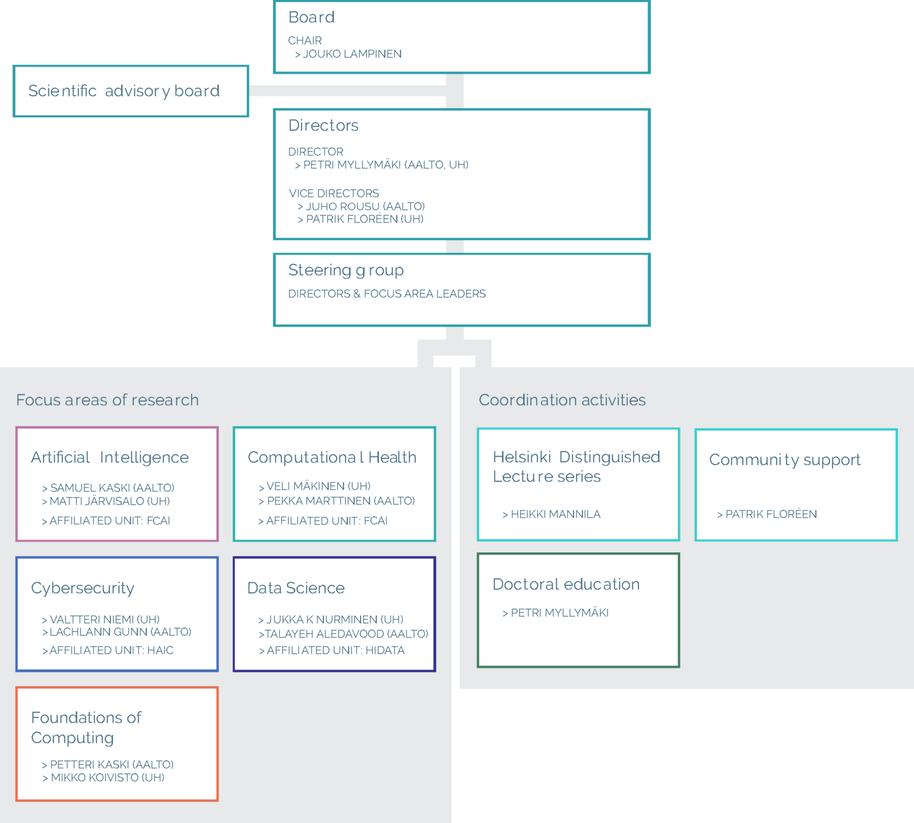
The organisation chart of HIIT in 2025.
At Aalto University, HIIT is administratively supported by the Department of Computer Science and the associated service personnel. Similarly, at the University of Helsinki the administration is handled together with the Department of Computer Science. However, the activities o2f HIIT span much wider beyond these departments, and HIIT actively supports the Helsinki ICT community as a whole (see the Community Support programme). In research, the activities of HIIT focus on supporting cross-cutting, grand-challenge type focus areas that involve people from not only the CS departments of the two host universities, but also researchers from the Department of Information and Communications Engineering of the Aalto School of Electrical Engineering and at the University of Helsinki people from the Department of Mathematics and Statistics, the Helsinki Institute of Life Science and the Helsinki Centre for Digital Humanities. In administration, the key people supporting HIIT activities were Christina Sirviö (coordinator of HIIT), Katri Karhunen (coordinator of HIIT and FCAI), and Kaisa Pekkala (coordinator of FCAI).
In 2025, HIIT supported the following strategic focus areas:
The highest decision-making body of HIIT is the Board. It decides on HIIT’s overall research strategy and research programmes. The statutory tasks of the Board are to approve the annual budget and activity plans, and follow up and comment on the work of HIIT through regular activity updates given by the Director of HIIT. In 2025 the Board convened four times.
The HIIT Board consists of eight members, each with a personal deputy. Both parent universities appoint two academic members. In addition, they appoint together three members who are not employed by either university. One member is elected by HIIT personnel.
The HIIT board served a four-year term from 1 April 2022 to 31 March 2026. For 2025, the Board consisted of the following members (personal deputies in parentheses):
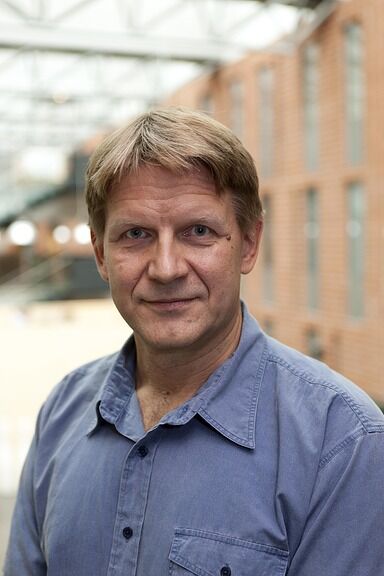



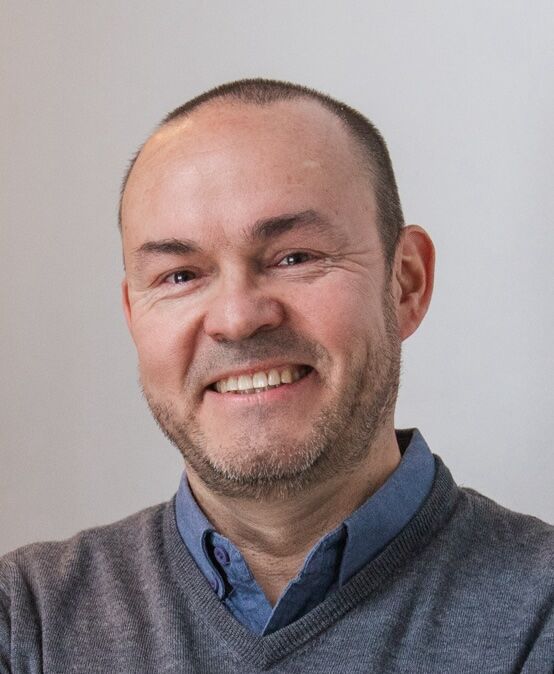


The Director of HIIT, Professor Petri Myllymäki, is responsible for preparing and submitting propositions to the Board.
The Secretary of the Board in 2025 was HIIT’s Vice-Director Patrik Floréen.


The SAB consists of internationally prominent scholars who are invited by the HIIT Board. The objective of the SAB is to provide critical guidance about HIIT’s research activities and to advise the HIIT Board on strategic planning for future research directions of HIIT. The SAB convenes once in approximately 4 years, the last time 9-10 June 2025. The members of the SAB in the meeting in 2025 were:



HIIT received in year 2025 own funding from Aalto University and from University of Helsinki, 750 000 euro from each. The following table shows how the funding was allocated.
Table 1: HIIT own university funding 2025.
| HIIT (thousand euros) | Aalto | UH | Total |
| Strategic Recruitment | 510 | 510 | 1020 |
| Community Support | 60 | 60 | 120 |
| Administration | 180 | 180 | 360 |
| Total | 750 | 750 | 1500 |
As can be seen from the table, the funding is directed towards hiring HIIT postdoctoral researchers (“Strategic Recruitment”), see HIIT Fellows and supporting activities of the Helsinki ICT community (“Community Support”), see below for a more detailed report. The administrative costs are salaries for the Director and some other persons supporting the Helsinki ICT Community, see Organisation. Aalto University’s Department of Computer Science and the University of Helsinki’s Department of Computer Science provide general support to HIIT, in relation to e.g. finance and HR. Each researcher is employed at a department and receives administrative support (e.g. IT equipment, HR services) from their home department.
HIIT supported the Helsinki ICT Community by providing funding for the following activities:
This funding was not limited to the HIIT focus areas but was open to the whole Helsinki ICT community. In addition, it served an important purpose by being applicable to cases where other funding instruments were not easily available or the funding from other sources was insufficient. For a sample of the activities supported by HIIT, please see Highlights.
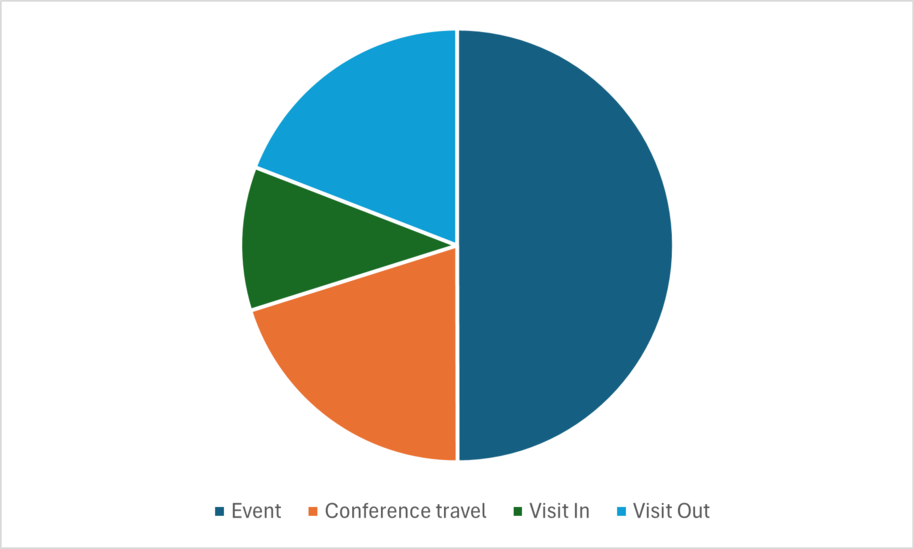
In 2025, HIIT funded 8 Community Support proposals: 50% of funding was spent on events, 19% on Visits out, 20% on Conference travel and 11% on visits in.
We funded events such as the Helsinki Digital Humanities Hackathon #DHH25, Helsinki Computational Social Science Day, HIIT Open 2025, Helsinki Algorithms and Theory Days 2025.
In addition to the speakers invited for the Distinguished Lecture Series, we invited Professor Tsvi Kuflik to give a talk and collaborate with those in our ICT community.
Finally we supported two PhD students: one student was supported in a longer research visit and the other was supported to present their work at a conference.